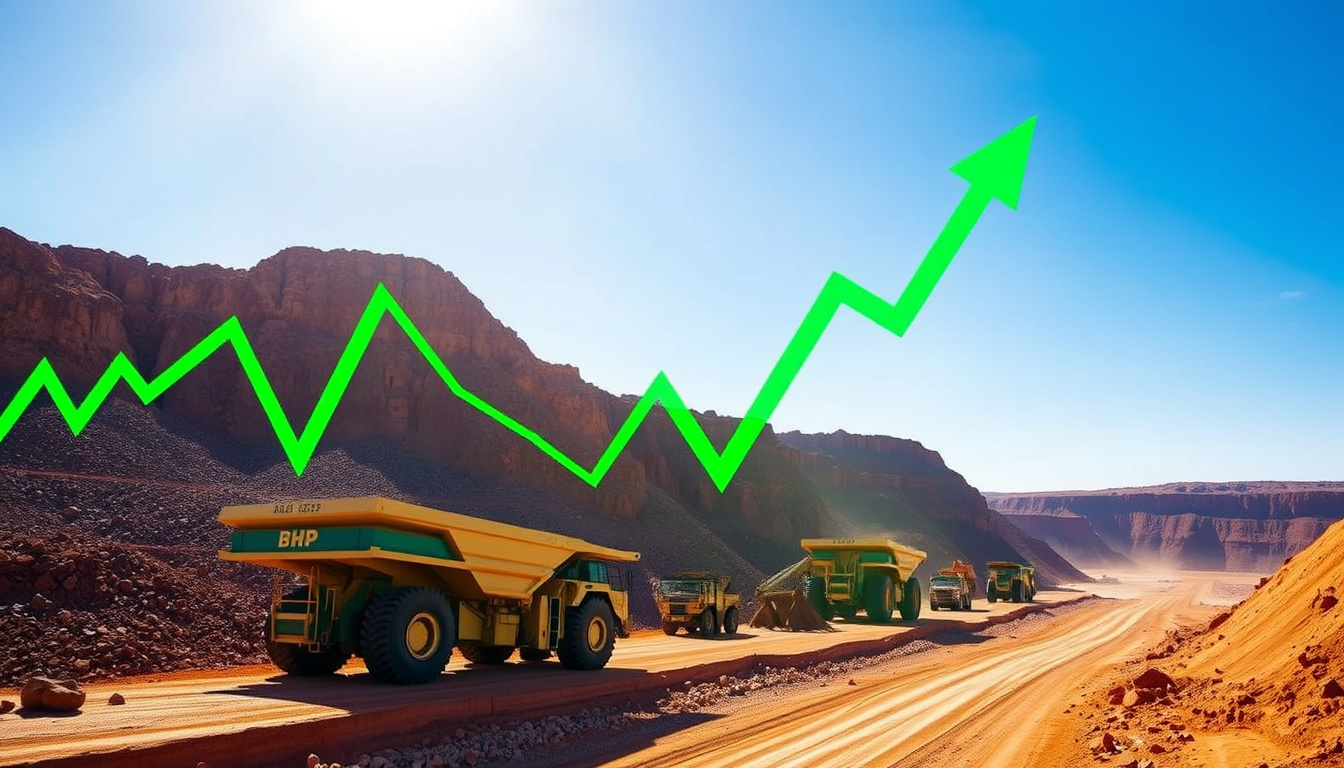
BHP Group Ltd stands as one of the world’s largest mining companies, commanding a market capitalisation of approximately AUD 221 billion on the Australian Securities Exchange. The Melbourne-headquartered giant operates across multiple continents, extracting and processing iron ore, copper, coal, oil, and gas while employing roughly 62,000 people worldwide.
Investors tracking ASX:BHP have witnessed significant price movements in recent sessions, with the share hovering around the AUD 55 level. The company’s dual-listed structure spans both the ASX and the London Stock Exchange, making it accessible to a broad base of institutional and retail shareholders seeking exposure to global commodity markets.
This profile examines BHP’s current trading dynamics, dividend performance, operational footprint, and financial standing based on publicly available market data and official filings. Those considering BHP as part of a diversified portfolio should familiarise themselves with the factors influencing mining sector valuations.
BHP Share Price and Trading Performance
The ASX:BHP share price has demonstrated notable volatility over the past twelve months, trading within a 52-week range of AUD 59.39 at the high end down to considerably lower levels. Recent trading sessions have shown intraday movement of approximately 3.22%, reflecting ongoing market reassessment of commodity sector valuations amid shifting global demand patterns.
BHP Group Ltd
ASX:BHP
~AUD 221 billion
Mining (Iron Ore, Copper)
Key Trading Metrics
Several financial indicators provide insight into BHP’s current market positioning. The trailing twelve-month earnings per share stands at AUD 2.75, supporting a price-to-earnings ratio of 15.88. The company’s beta of 0.97 indicates volatility roughly in line with the broader market, while the float of 4.82 billion shares ensures substantial daily liquidity for investors entering or exiting positions.
- Current share price approximately AUD 55.78–55.95 with recent daily movement of 2.63–3.22%
- 52-week high of AUD 59.39 contrasts with historical all-time high of AUD 50.84 achieved in December 2023
- Year-end closing prices show 2024 at AUD 42.68, 2023 at AUD 44.99, and 2022 at AUD 41.25
- One-year performance lags the mining sector by 5.45% and underperforms the ASX 200 by 14.08%
- P/E ratio (TTM) of 15.88 suggests moderate valuation relative to earnings
- Shares outstanding float of 4.82 billion with EPS (TTM) of AUD 2.75
- Liquidity remains strong, with daily trading volumes supporting institutional participation
Share price data varies across sources due to timing differences and data refresh cycles. Investors should consult real-time quotation services for the most current pricing information when making investment decisions.
Historical Price Context
BHP’s share price history reflects broader commodity cycles and corporate restructuring. The stock reached an all-time low of AUD 2.98 in January 1991, prior to the 2001 merger with Billiton that created the modern BHP Group. Current prices represent substantial recovery from pandemic-era lows of AUD 35.82 recorded at the end of 2020. Historical market data from Australian market indices provides useful context for evaluating relative performance over extended periods.
| Metric | Value | Notes |
|---|---|---|
| 52-Week High | AUD 59.39 | Current cycle peak |
| All-Time High | AUD 50.84 | December 28, 2023 |
| All-Time Low | AUD 2.98 | January 10, 1991 |
| P/E Ratio (TTM) | 15.88 | Trailing twelve months |
| Beta (1-Year) | 0.97 | Market-aligned volatility |
| Shares Float | 4.82 billion | Tradeable shares |
| EPS (TTM) | AUD 2.75 | Earnings per share |
| Market Cap | ~AUD 221 billion | Based on current pricing |
Company Operations and Global Asset Base
BHP operates as a global resources company with principal operations spanning iron ore, copper, coal, petroleum, and potash. The company maintains headquarters in Melbourne, Australia, and maintains a significant corporate presence in key mining jurisdictions including Chile, the United States, and Western Australia. Global mining sector data from Reuters commodity markets coverage offers additional context for understanding BHP’s competitive positioning.
Core Commodities and Production Assets
Iron ore remains BHP’s flagship product, driving the majority of revenue alongside copper operations. The company’s copper portfolio includes interests in some of the world’s most prolific copper deposits, positioning BHP as a major beneficiary of electrification trends and renewable energy infrastructure development. Industry analysis from Mining.com provides detailed coverage of global copper supply dynamics affecting operations like Escondida.
- Iron Ore: Western Australian operations represent core production capacity
- Copper: Escondida in Chile holds distinction as the world’s largest copper mine
- Olympic Dam: South Australian asset producing copper and uranium
- Coal: Queensland coking and thermal coal operations
- Petroleum: Offshore oil and gas assets in multiple basins
The Escondida mine in northern Chile produces more copper than any other single operation globally. This asset alone accounts for approximately 5% of world copper output, making it strategically significant for both BHP and global copper supply chains.
Leadership and Corporate Structure
Mike Henry serves as Chief Executive Officer, steering the company through commodity cycles and capital allocation decisions. The organisational structure reflects BHP’s dual listing on both the ASX and LSE, requiring compliance with Australian, UK, and international regulatory frameworks governing listed entities.
Financial Performance and Dividend Policy
BHP’s financial results demonstrate the scale and profitability achievable in global mining. Full-year revenue of AUD 79.15 billion and net income of AUD 13.93 billion underscore the company’s position as one of Australia’s most profitable corporate entities. These figures reflect operational efficiency across geographically diverse asset portfolios. Comprehensive financial data on Australian listed companies is available through ASX official market data.
Dividend History and Yield
Shareholders benefit from BHP’s consistent dividend policy, with fully franked distributions providing tax advantages for Australian investors. The indicated dividend yield of approximately 3.93% and 2025 projected yield of 4.65% attract investors seeking both capital appreciation and income generation from their equity holdings.
| Payment Date | DPS (AUD) | Franking | Gross DPS (AUD) | Type |
|---|---|---|---|---|
| 06/03/2025 | 0.7909 | 100% | 1.1299 | Interim |
| 12/09/2024 | 1.11 | 100% | 1.5857 | Final |
| 07/03/2024 | 1.0962 | 100% | 1.566 | Interim |
| 07/09/2023 | 1.2507 | 100% | 1.7866 | Final |
The trailing twelve-month dividend per share of AUD 1.9009, grossing to AUD 2.7156 with franking credits, represents a payout ratio of 54%. This indicates sustainable distribution levels with room for growth during favourable commodity cycles.
Balance Sheet Strength
Financial resilience appears evident in BHP’s balance sheet metrics. Interest cover ranging from 25.0 to 31.2 demonstrates comfortable debt servicing capacity, while net debt-to-equity ratios between 18.1% and 25.9% reflect prudent capital structure management. Return on equity spanning 18.0% to 28.7% indicates effective deployment of shareholder capital.
BHP reports in Australian dollars, though substantial operations in Chile and the United States introduce foreign exchange considerations. Commodity prices quoted in US dollars combined with AUD reporting creates currency translation effects that influence reported financial results.
Commodity Exposure and Market Dynamics
BHP’s business model centres on extracting and selling industrial commodities, making the company inherently sensitive to global economic conditions. Iron ore and copper prices fluctuate based on supply developments, Chinese infrastructure spending, and broader manufacturing activity across Asia and emerging markets. For context on global commodity price movements, World Bank commodity price data provides comprehensive historical analysis.
Demand Drivers and Risk Factors
China represents the dominant demand driver for BHP’s iron ore business, with infrastructure and construction activity directly influencing pricing. The transition toward electric vehicles increases copper intensity per vehicle, supporting long-term demand forecasts for this commodity. Steel production trends covered by World Steel Association offer useful indicators for iron ore demand forecasting.
- Iron ore demand closely tied to Chinese construction and manufacturing cycles
- Copper benefits from electrification and renewable energy buildout globally
- Coal operations face secular pressure from energy transition policies in developed markets
- Petroleum assets subject to fossil fuel consumption trends and energy policy uncertainty
Commodity price volatility represents the primary risk factor for BHP shareholders. Economic slowdowns in major consuming nations can rapidly compress margins and free cash flow generation. Conversely, supply disruptions or demand surges create meaningful earnings upside potential.
Corporate History and Strategic Evolution
The modern BHP Group emerged from the 2001 merger of BHP Limited and Billiton Plc, combining Australian mining heritage with international assets. This transaction created one of the world’s first truly global diversified mining companies, spanning multiple commodities and geographies.
Long-Term Value Creation
Long-term shareholders have witnessed substantial value creation since the company’s early days trading near AUD 2.98. Peaks above AUD 50 reflect successful capital allocation, operational improvements, and commodity cycle tailwinds benefiting resource sector equities.
Key Milestones in BHP’s History
- 1885: Broken Hill Proprietary Company established in New South Wales
- 1960s–1980s: Expansion into iron ore, coal, and petroleum
- 2001: Merger with Billiton creates BHP Billiton Limited
- 2011: Unification of dual-listed structure under single parent
- 2020: Petroleum spin-off into Woodside Energy completed
- 2023: All-time high share price achieved
What’s Established and What Remains Uncertain
| Established Information | Information Requiring Verification |
|---|---|
| Market capitalisation approximately AUD 221 billion | Detailed 2024 annual report contents |
| Current CEO Mike Henry | Specific production volume figures |
| Melbourne headquarters location | Analyst buy/sell consensus ratings |
| Olympic Dam and Escondida as key assets | Current ESG performance metrics |
| Full-year revenue AUD 79.15 billion | Near-term commodity price forecasts |
| Fully franked dividend history | China demand near-term outlook |
| 62,000 global workforce | Future capital allocation priorities |
While core operational and financial data receives regular reporting through ASX announcements, certain forward-looking and qualitative information requires direct consultation with BHP’s investor relations resources and official filings.
Market Position and Investment Considerations
BHP occupies a commanding position within the global mining sector, ranking among the world’s largest diversified resource companies. The company’s scale provides advantages in capital allocation flexibility, operational expertise across multiple commodity cycles, and negotiating leverage with customers and suppliers.
Fundamental strengths include strong liquidity metrics with cash flow from operations to current liabilities ranging from 98% to 144%. Asset turnover approximating 0.5 demonstrates efficient utilisation of the substantial asset base. However, recent one-year performance lagging both the sector and broader ASX 200 benchmarks warrants attention regarding near-term momentum.
For retirement planning purposes, resource sector equities like BHP can provide portfolio diversification alongside defensive positions. Understanding how commodity exposures complement other holdings matters for those constructing portfolios through vehicles such as an Australian Retirement Fund Guide.
Accessing Official Information and Filings
Investors seeking authoritative information should access official channels for current data and announcements. The ASX company page for BHP provides regulatory filings, price history, and announcements to the market. BHP’s own investor relations site offers supplementary information including current share price updates and shareholder resources. Official filings and market announcements are accessible through ASX:BHP company page.
Those requiring context on broader economic conditions affecting commodity demand may find value in Australian Bureau of Statistics data on mining sector performance and world bank analysis of global commodity markets.
“BHP’s operations span iron ore, copper, coal, oil, and gas across the Americas and Australia.”
— BHP investor documentation and market research sources
Summary and Key Takeaways
ASX:BHP represents a major holding for investors seeking commodity sector exposure on the Australian market. The company’s approximately AUD 221 billion market capitalisation, consistent fully franked dividends yielding around 4%, and position as operator of tier-one assets including Escondida and Olympic Dam establish it as a significant ASX constituent.
Trading at a P/E ratio of approximately 15.88 with beta near 1.0 indicates market-aligned risk-return characteristics typical of large-cap mining stocks. Near-term performance has lagged sector and index benchmarks, though long-term shareholders have benefited from substantial appreciation from historical lows. Those tracking dividend income alongside capital returns may find BHP relevant when reviewing their Tax Return 2025 Guide implications of fully franked distributions.
Frequently Asked Questions
What is BHP’s current share price on the ASX?
BHP shares trade around AUD 55.78–55.95 on the ASX, with daily movements of approximately 2–3% observed in recent sessions. Real-time pricing should be confirmed through ASX market data services.
What dividend does BHP pay shareholders?
BHP’s trailing twelve-month dividend per share totals AUD 1.9009, fully franked, representing a gross dividend of AUD 2.7156. The indicated yield is approximately 3.93%, with 2025 projected at 4.65%.
Where is BHP headquartered?
BHP Group maintains global headquarters in Melbourne, Australia. The company also maintains significant operational offices in Chile and other key mining jurisdictions.
What are BHP’s main products?
BHP produces iron ore, copper, coal, oil, gas, and potash. Iron ore and copper represent the largest revenue contributors, with assets including the Escondida mine in Chile and Olympic Dam in South Australia.
What is BHP’s market capitalisation?
BHP’s market capitalisation stands at approximately AUD 221 billion, making it one of the largest listed companies on the ASX and a major component of Australian equity indices.
How can I access BHP’s ASX announcements?
Official ASX announcements, financial reports, and market data are available through the ASX company page at asx.com.au/markets/company/BHP. BHP investor relations also provides direct access to filings.
Who is BHP’s CEO?
Mike Henry serves as Chief Executive Officer of BHP Group, leading the company through commodity cycles and strategic initiatives including portfolio optimisation and sustainability commitments.
Does BHP have a dividend reinvestment plan?
Yes, BHP offers a Dividend Reinvestment Plan allowing shareholders to elect reinvestment of cash dividends into additional shares rather than receiving payment in cash.
Related stories



Liam O'Brien covers Australian politics and public affairs for Coast Brief.