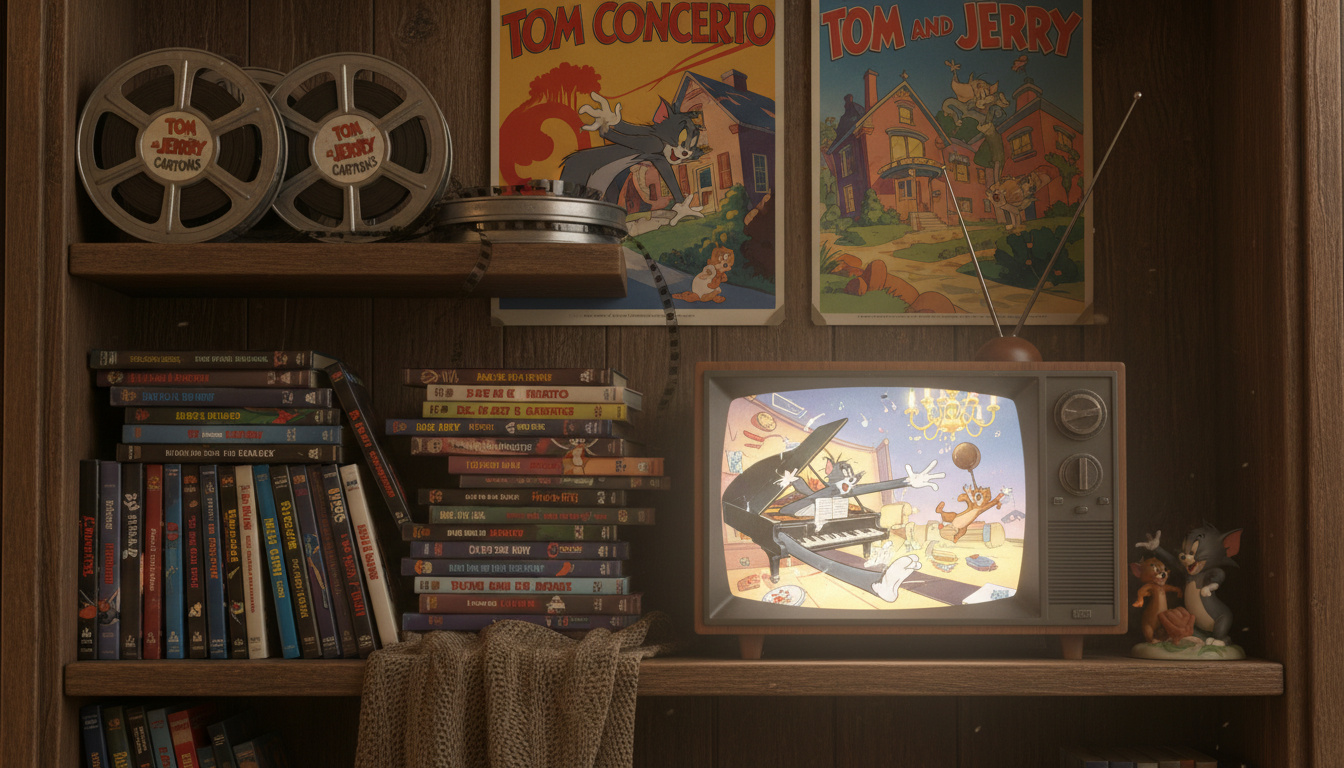

Tom and Jerry stands as one of the most enduring animated franchises in entertainment history. Created in 1940 by William Hanna and Joseph Barbera for Metro-Goldwyn-Mayer (MGM), the series centers on the perpetual rivalry between Tom, a domesticated house cat, and Jerry, a clever brown mouse. The formula relies on slapstick physical comedy and minimal dialogue, establishing a universal language of chase sequences that has translated across cultures for over eight decades.
The franchise encompasses 161 theatrical short films produced during the Golden Age of American animation, seven Academy Awards for Best Animated Short, and numerous television revivals and feature films. Unlike many animated series that rely on verbal wit, Tom and Jerry communicates narrative through exaggerated action, facial expressions, and the occasional blood-curdling scream, creating a timeless appeal that predates the television era and continues through modern streaming platforms.
What Is Tom and Jerry?
- Seven Academy Awards for Best Animated Short Film, including Yankee Doodle Mouse (1943) and The Cat Concerto (1946)
- Minimal dialogue approach using mostly sound effects, screams, and occasional songs rather than spoken conversation
- Universal appeal transcending language barriers through physical comedy and visual storytelling
- Character evolution from unnamed prototypes to fully realized personalities over decades
- Contemporary availability on multiple streaming platforms though specific content varies by region
| Attribute | Tom | Jerry | Franchise Notes |
|---|---|---|---|
| Species | Domesticated house cat | House mouse | No specific breed confirmed for Tom |
| Original Name | Jasper (in debut) | Jinx (in debut) | Changed to Tom and Jerry after contest |
| Personality | Initially milder, later frustrated predator | Clever, ingenious, resourceful | Dynamic shifted over 161 shorts |
| Voice | Sound effects, screams, rarely speaks | Squeaks, effects, rarely speaks | 1992 film featured regular dialogue |
| First Appearance | Puss Gets the Boot (1940) | Released February 10, 1940 | |
| Current Status | Warner Bros. franchise property | Includes films, TV, merchandise | |
Who Created Tom and Jerry and When Did It Start?
The Hanna-Barbera Partnership at MGM
William Hanna and Joseph Barbera developed the concept while working in the MGM cartoon studio during the late 1930s. Their first collaboration, Puss Gets the Boot, debuted in 1940 and established the adversarial relationship between a cat and mouse, though the characters remained unnamed in this initial outing. The short succeeded commercially despite costing approximately $30,000 to produce, prompting MGM to request additional entries in what would become a seventeen-year theatrical run.
How the Names Were Chosen
The names “Tom” and “Jerry” emerged from an internal studio contest rather than the creators’ original intent. Animator John Carr won the competition by suggesting the monikers, which replaced the working titles “Jasper” and “Jinx” used in the debut short.
The theatrical era spanning 1940 to 1958 represents the Golden Age of the franchise. During this period, Hanna and Barbera supervised 161 short films for MGM, developing increasingly elaborate chase sequences and introducing recurring characters such as Mammy Two Shoes, the maid who owns Tom in many early episodes. The animation quality utilized Technicolor and sophisticated orchestral scores, distinguishing these works from lower-budget television animation that would dominate later decades.
Post-MGM Transitions
Hanna and Barbera departed MGM in 1958 to establish their own television animation studio. Subsequent revivals occurred under different directors: Gene Deitch produced shorts in Czechoslovakia during the early 1960s, followed by Chuck Jones, who softened the violence and refined the character designs at Sib Tower 12 Productions. Ownership eventually transferred to WarnerMedia, now Warner Bros., which manages contemporary iterations of the property.
Who Are the Main Characters in Tom and Jerry?
Tom the Cat
Tom appears as a generic domesticated house cat without specific breed designation, though his tuxedo coloring suggests mixed ancestry. His personality evolved significantly across the original theatrical run, beginning as a somewhat docile predator and developing into an increasingly frustrated, scheming antagonist whose elaborate traps consistently backfire. While primarily motivated by the instinct to catch Jerry, Tom occasionally displays pathos and vulnerability, particularly in episodes where he faces eviction or humiliation.
Jerry the Mouse
Jerry’s design as a small brown house mouse remains consistent throughout the franchise’s history. His character relies on ingenuity rather than strength, often utilizing household objects and environmental advantages to outwit his feline pursuer.
Jerry functions as the traditional trickster archetype, utilizing superior intelligence and environmental adaptability to defeat Tom’s physical advantages. Unlike many cartoon protagonists of the era, Jerry actively provokes conflict rather than merely defending himself, establishing a complex moral dynamic where neither character maintains consistent moral superiority. The mouse rarely speaks, communicating through high-pitched vocalizations, whistles, and expressive body language.
Voices and Supporting Cast
The original theatrical shorts utilized minimal voice acting, relying instead on recorded sound effects and musical scoring. Voice actors contributed screams, gasps, and occasional sung lines rather than dialogue. Later iterations, including Kim Seon-ho biography television revivals, maintained this tradition. Joe Barbera provided the voice for Tom’s owner in The Mansion Cat (2001), a rare instance of creator participation in voice work. Thea Vidale redubbed Mammy Two Shoes in later broadcasts to remove original stereotypical vocal characteristics.
How Many Episodes and Seasons Does Tom and Jerry Have?
Early episodes from the 1940s and 1950s contain racial stereotypes, particularly regarding the character Mammy Two Shoes and various ethnic caricatures. Modern broadcasts on Cartoon Network and Boomerang utilize edited versions with altered voiceovers and modified opening sequences.
The original theatrical run produced exactly 161 short films between 1940 and 1958, with no traditional season structure as the content premiered in cinemas rather than broadcasting schedules. These shorts vary in length from seven to ten minutes and were designed to accompany feature films as part of theatrical programs.
Television adaptations introduced seasonal structures decades later. The Tom and Jerry Show (1975-1977) produced 48 new seven-minute stories across 16 episodes. Subsequent series include Tom & Jerry Kids (1990-1993), which reimagined the characters as children, Tom and Jerry Tales (2006-2008), and the 2014-2021 reboot of The Tom and Jerry Show. The total episode count across all iterations extends into the hundreds, though exact totals vary depending on whether theatrical shorts, television segments, and specials are combined.
What Tom and Jerry Movies and Spin-Offs Exist?
Feature Films and Direct-to-Video Releases
The franchise expanded into feature-length productions beginning with 14 distinct films produced between 1992 and 2021. Tom and Jerry: The Movie (1992/1993) marked the first theatrical feature, controversially introducing regular dialogue for both characters, a departure from the silent-comedy tradition that received criticism for weak musical numbers and box office underperformance.
The 2021 live-action/animated hybrid film, featuring the characters occupying a hotel where a wedding takes place, grossed over $100 million worldwide despite mixed critical reception. Direct-to-video productions include holiday specials, crossover films with other Warner Bros. properties, and The Mansion Cat (2001), a television special featuring Joe Barbera’s voice work.
Television Revivals and Digital Content
Beyond theatrical animation, numerous television series have extended the franchise’s longevity. The Tom and Jerry Comedy Show (1980-1982) revived the characters for Saturday morning audiences, while the 2014 series utilized Flash animation techniques for 325-minute episodes. Video games, mobile applications, and branded merchandise continue to utilize the characters across multiple platforms and media formats.
Where Can You Watch Tom and Jerry Today?
Current distribution places the classic theatrical shorts primarily on the Boomerang streaming service and the Max platform (formerly HBO Max), though availability fluctuates based on licensing agreements and regional restrictions. Cartoon Network maintains broadcast rights for edited versions suitable for contemporary audiences, removing or modifying content containing outdated racial stereotypes.
Physical media collections, including Blu-ray and DVD releases, offer the most complete archival access, often preserving original theatrical versions alongside edited broadcast cuts. YouTube hosts official clips and selected full episodes through Warner Bros. official channels, though these represent curated selections rather than comprehensive libraries. Viewers seeking specific banned or controversial episodes must typically seek archival DVDs or specialized collections, as mainstream platforms have removed the most problematic entries from rotation.
How Did Tom and Jerry Evolve Across Eight Decades?
- : Puss Gets the Boot debuts in theaters; characters unnamed
- : Hanna and Barbera produce 161 theatrical shorts at MGM
- : Creators depart MGM to form Hanna-Barbera Productions
- : Gene Deitch directs 13 shorts in Czechoslovakia
- : Chuck Jones era produces 34 shorts with redesigned characters
- : The Tom and Jerry Show premieres on CBS
- : Tom & Jerry Kids reimagines characters as children
- : First feature film with spoken dialogue released
- : The Mansion Cat TV special airs
- : Modern reboot series streams on various platforms
- : Live-action/animated hybrid film released theatrically
What Remains Verified vs. Uncertain About the Franchise?
Established Facts
- Created by William Hanna and Joseph Barbera in 1940
- Exactly 161 theatrical shorts produced for MGM (1940-1958)
- Won seven Academy Awards for Best Animated Short Film
- Names originated from studio contest won by John Carr
- Currently owned by Warner Bros. Discovery
- Characters appear as generic house cat and mouse without specific breeds
Unsettled or Unclear
- Total episode count including all international spin-offs and foreign co-productions
- Specific streaming rights for 2024-2025 (subject to ongoing licensing negotiations)
- Whether future theatrical shorts will return to the franchise
- Complete details regarding banned episodes and their specific edit histories
- Future television series or film projects currently in development
What Cultural Context Shaped This Animation Icon?
The franchise emerged during the Golden Age of American animation, when studios like MGM competed with Disney and Warner Bros. for theatrical audiences. The minimal dialogue approach reflected both artistic choice and practical necessity, as physical comedy translated more effectively to international markets than verbal humor during the World War II era and subsequent reconstruction period.
Violence in the series, while exaggerated and non-lethal, generated controversy particularly during the 1970s when parents and critics questioned whether slapstick brutality influenced children negatively. The content has never faced wholesale banning, though editing practices have evolved to remove racially insensitive material while retaining the physical comedy core. The rivalry dynamic—representing the futile pursuit rather than the capture—resonates across cultures as a fundamental comedic structure.
What Do Primary Sources and Experts Document?
The essence of Tom and Jerry is pure chase comedy, where the anticipation of the disaster is funnier than the disaster itself.
— William Hanna, co-creator
Historical documentation from Britannica and archival studio records confirm the franchise’s status as the most-awarded theatrical cartoon series in Academy history. Contemporary analysis published in animation histories notes the technical sophistication of the MGM era, particularly the integration of classical music scores with synchronized action choreography. The La Sagrada Familia visitor guide contrast provides interesting cultural timeline parallels, as both represent long-term creative endeavors spanning multiple decades of development.
Why Does the Cat-and-Mouse Chase Endure?
Tom and Jerry persists in popular culture through its mastery of universal visual storytelling, transcending linguistic and generational barriers while adapting to evolving distribution technologies. The franchise’s 80-plus-year history encompasses multiple animation techniques, from hand-drawn theatrical shorts to digital television series, maintaining relevance through the fundamental appeal of well-crafted physical comedy rather than topical references or dialogue-dependent humor.
Common Questions About the Franchise
Why is Tom and Jerry considered violent?
The shorts feature exaggerated slapstick including explosions, falls from heights, and object impacts. While no character sustains permanent injury, the cartoon violence prompted editing in later broadcasts and criticism from child development experts during the 1970s.
What breed is Tom the cat?
Tom is a generic domesticated house cat with tuxedo coloring. No specific breed has ever been officially assigned to the character in production notes or creator interviews.
Are any Tom and Jerry episodes banned?
Episodes featuring Mammy Two Shoes and certain ethnic caricatures from the 1940s-1950s no longer air on mainstream networks. Cartoon Network and Boomerang broadcast edited versions with altered voiceovers and removed scenes.
Who provides the voices for Tom and Jerry?
The original theatrical shorts utilized sound effects rather than voice actors. William Hanna provided many of Tom’s screams. The 1992 feature film introduced regular dialogue with Richard Kind voicing Tom and Dana Hill as Jerry.
Is Tom and Jerry available on Netflix?
Availability varies by region and licensing agreements. The franchise currently streams primarily on Max (formerly HBO Max), Boomerang, and Cartoon Network platforms rather than Netflix, though specific titles may appear temporarily.
Did Tom ever catch Jerry in the original cartoons?
Tom occasionally succeeds in capturing Jerry, but the mouse inevitably escapes or Tom loses his advantage due to external interference or his own incompetence. No permanent capture occurs in the theatrical canon.
What was the first Tom and Jerry cartoon?
Puss Gets the Boot (1940) featured the debut of the cat and mouse, originally named Jasper and Jinx. The names Tom and Jerry appeared in the second short, The Midnight Snack (1941).

Rachel Walsh leads fact-checking, source verification and corrections at Coast Brief.