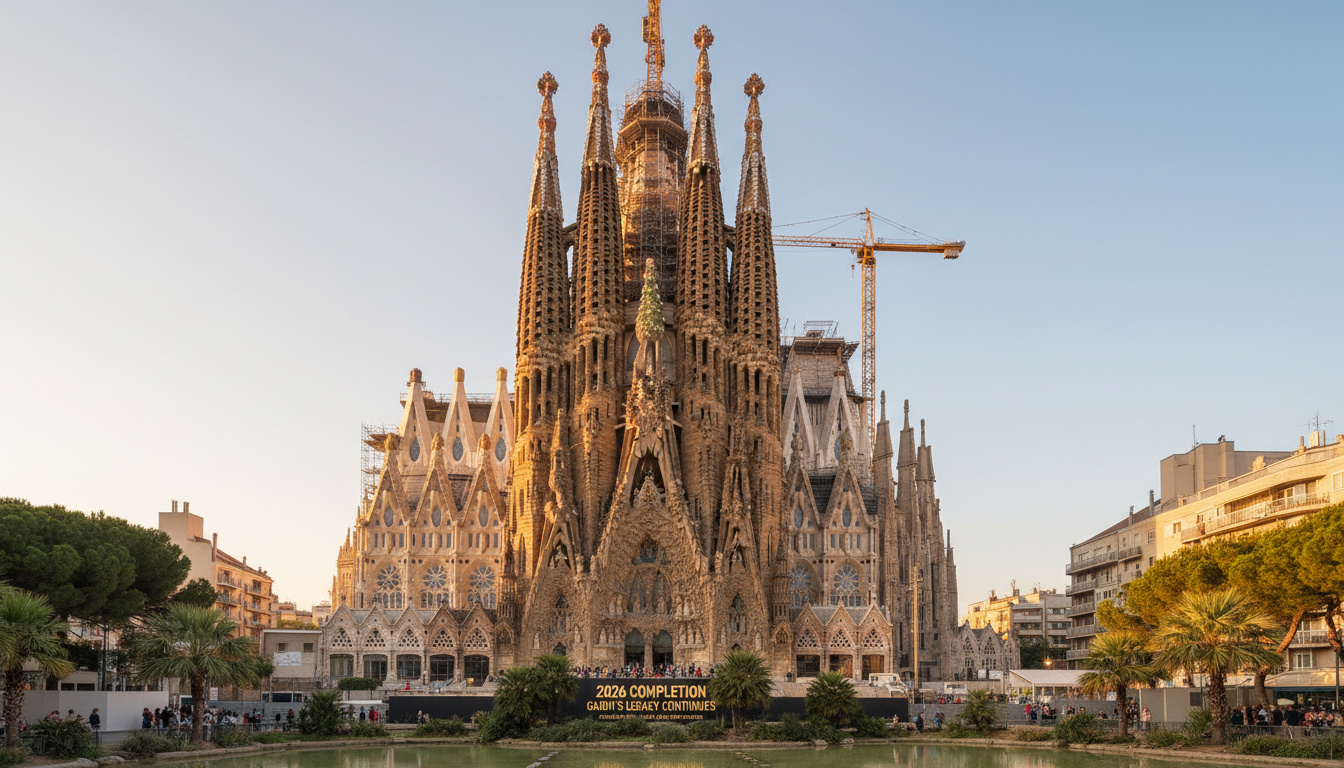

La Sagrada Família rises from the Eixample district of Barcelona as one of architecture’s most ambitious endeavors. Antoni Gaudí’s unfinished masterpiece has dominated the city’s skyline for more than 140 years, drawing millions of visitors annually who come to witness its intricate facades and soaring spires.
Construction began in 1882 under architect Francisco de Paula del Villar, though Gaudí assumed control one year later, transforming the project into a revolutionary synthesis of Gothic and Art Nouveau elements. Today, the basilica approaches its final stages, with officials targeting completion by 2026 to coincide with the centenary of Gaudí’s death.
When Will La Sagrada Família Be Completed?
- UNESCO World Heritage designation since 2010
- 18 spires planned representing religious figures including Jesus, Mary, and the Evangelists
- Approximately 4.7 million annual visitors according to recent tourism data
- Funded entirely by private donations and ticket sales without government subsidies
- Central tower reaches final height of 172.5 meters as of 2023
- Construction progress reportedly at 70% completion of total architectural program
| Fact | Detail |
|---|---|
| Total Height | 172.5 meters (central tower) |
| Annual Visitors | Approximately 4.7 million |
| Planned Towers | 18 (12 completed as of 2024) |
| UNESCO Status | World Heritage Site (2010) |
| Construction Start | 1882 |
| Current Status | Approximately 70% complete |
| Target Completion | 2026 (centenary of Gaudí’s death) |
| Architectural Style | Gothic and Art Nouveau fusion |
| Funding Model | Private donations and visitor revenue |
| District Location | Eixample, Carrer de Mallorca 401 |
History and Construction Timeline of La Sagrada Família
Origins and Early Development
The project commenced in 1882 with Francisco de Paula del Villar’s conventional Gothic Revival design. Financial disputes led to his resignation within months, opening the door for a 31-year-old Antoni Gaudí to assume leadership in 1883. The Historical Evolution of Gaudi’s Greatest Work documents how the new architect abandoned the original plans in favor of a groundbreaking fusion of natural forms and religious symbolism.
Gaudí’s Final Years and Legacy
Gaudí dedicated his final decades exclusively to the basilica, living as a recluse on the construction site. His death in 1926 left the project approximately 15-25% complete, with only one facade, one tower, and the crypt finished. Subsequent generations of architects have worked to interpret his complex models and sketches, many of which were destroyed during the Spanish Civil War.
Current chief architect Jordi Faulí i Oller continues to rely on Gaudí’s original plaster models and geometric studies, supplemented by computer-aided design technologies unavailable in the early 20th century.
How to Visit La Sagrada Família: Tickets and Practical Tips
Ticket Options and Access
Entry requires advance reservation through the official Sagrada Família website or authorized vendors. Basic admission includes access to the nave and museum, while upgraded tickets permit tower ascents via elevator. Prices vary by season and access level, with discounts available for students, seniors, and children.
Planning Your Visit
Most visitors spend 1.5 to 2 hours exploring the interior and exterior facades. Morning light illuminates the Nativity Facade’s intricate sculptures, while afternoon sun enhances the Glory Facade’s golden tones. Barcelona Tourism officials recommend booking tickets 3-4 weeks in advance during peak season.
Accessibility and Guidelines
The basilica offers wheelchair access to the main floor and elevators to certain towers, though narrow spiral staircases limit some areas. Dress codes require covered shoulders and knees, enforced at entry checkpoints.
Key Facts About La Sagrada Família’s Location and Significance
Located in the Eixample district at Carrer de Mallorca, 401, the basilica stands as Barcelona’s most visited monument. Its UNESCO World Heritage designation recognizes its exceptional contribution to the development of architecture and construction technology.
Upon completion, the central tower dedicated to Jesus Christ will stand at 172.5 meters, making it the tallest religious building in Europe and the tallest structure in Barcelona, deliberately designed to remain shorter than Montjuïc mountain as Gaudí believed human creation should not surpass divine nature.
While 2026 marks the targeted completion for the six central towers, finishing the remaining decorative elements and secondary structures may extend into subsequent years, with final sculptural details potentially requiring additional time.
Construction Milestones: From 1882 to 2026
- – Foundation stone laid; construction begins under Francisco de Paula del Villar (source)
- – Antoni Gaudí appointed chief architect; design shifts toward organic Modernisme style (source)
- – Gaudí dies after being struck by a tram; less than 25% of project completed
- – Pope Benedict XVI consecrates the church; UNESCO grants World Heritage status (source)
- – Tower of the Virgin Mary completed and inaugurated
- – Jesus Christ tower topped with cross, reaching final height
- – Target completion for remaining evangelist towers and overall structural work
What Is Certain and What Remains Uncertain
| Established Facts | Remaining Variables |
|---|---|
| Construction actively continues daily with over 150 workers | Exact month/day of 2026 completion undetermined |
| 70% of total structure completed as of recent reports | Weather events or material delays could shift timeline |
| Funding secured through visitor revenue and private patronage | Final sculptural program timeline not publicly specified |
| Central tower height fixed at 172.5 meters | Specific opening dates for all tower elevators pending |
Cultural Impact and Architectural Significance
La Sagrada Família represents the pinnacle of Catalan Modernisme, a movement that integrated craft traditions with industrial innovations. Unlike Gaudí’s other Barcelona works such as Park Güell or Casa Batlló, the basilica demonstrates his mature geometric principles and structural daring.
The building’s hyperboloid structures and helicoidal columns drew inspiration from natural forms—trees, bones, and crystals—creating an organic architecture that preceded modern biomimicry by decades. Its completion will mark the end of the world’s longest-running active construction project on a religious building.
Expert Perspectives and Official Statements
“The completion of the Temple in 2026 will be a historic event for Barcelona and for architecture worldwide, fulfilling Gaudí’s vision of a forest of stone and light.” For those interested in motorsport, you can find the latest MotoGP Italia Mugello 2026 dates and ticket information at MotoGP Italia Mugello 2026.
— Sagrada Família Construction Board
“The architect Antoni Gaudí left us a monumental legacy, a difficult work to interpret but an easy one to admire.”
— Jordi Faulí i Oller, Chief Architect
Planning Your Visit to Barcelona’s Iconic Basilica
La Sagrada Família stands as a testament to architectural persistence and spiritual devotion, approaching completion after more than 140 years of construction. Visitors planning to witness this Sagrada Familia: A Historical Timeline of Gaudi’s Life Work should book tickets well in advance, particularly as the 2026 completion date approaches and interest intensifies.
Common Questions About La Sagrada Família
What is La Sagrada Familia famous for?
Its distinctive blend of Gothic and Art Nouveau architecture, intricate stone facades depicting biblical scenes, and status as Antoni Gaudí’s final masterpiece.
How tall is La Sagrada Familia?
The central Jesus Christ tower reaches 172.5 meters (565 feet), designed to be the tallest religious structure in Europe while remaining below Barcelona’s Montjuïc mountain.
Is La Sagrada Familia a UNESCO site?
Yes, designated in 2010 as part of “Works of Antoni Gaudí,” recognizing its exceptional universal value to architectural history.
Can you enter La Sagrada Familia for free?
Free entry is restricted to specific religious services and special worship occasions. General admission requires purchased tickets.
How long should I plan to visit?
Allocate 1.5 to 2 hours for the main basilica and museum. Tower visits add approximately 30-45 minutes depending on queues.
Why has construction taken so long?
Interrupted by civil war, funding dependence on donations, complex stonework requiring skilled artisans, and the challenge of interpreting Gaudí’s evolving designs.
Who funds the construction now?
Private donations and ticket sales exclusively fund the project, receiving no government or church subsidies.
Related stories



Liam O'Brien covers Australian politics and public affairs for Coast Brief.