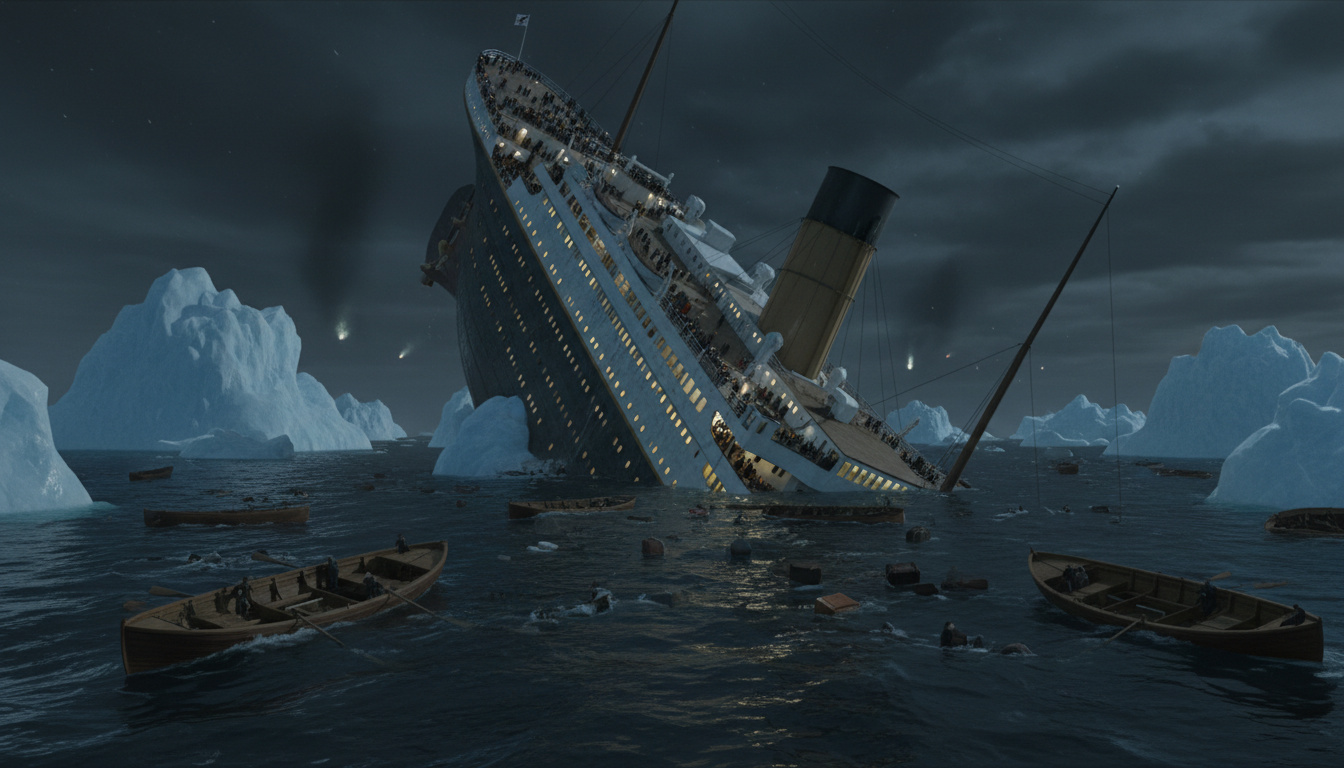

The RMS Titanic sank on April 15, 1912, after striking an iceberg in the North Atlantic, resulting in approximately 1,501 deaths out of 2,208 passengers and crew aboard. The catastrophe marked one of the deadliest peacetime maritime disasters in recorded history, with rescue vessels recovering only 711 survivors from the freezing waters.
The disaster’s human toll varied dramatically based on ticket class, gender, and location aboard the ship. First-class passengers survived at rates exceeding 60%, while third-class passengers faced mortality rates near 75%, and male passengers regardless of class saw survival chances below 20%.
Historical records contain slight discrepancies in the exact death toll, with British and American inquiries documenting marginal differences due to incomplete passenger manifests and undocumented stowaways. Understanding these figures requires examining official inquiry reports, survivor testimonies, and modern demographic analysis of the ship’s manifest.
How Many People Died on the Titanic?
- The British Wreck Commission established the death toll at 1,503, while the US Senate inquiry cited 1,517, creating a 14-person discrepancy in official records
- Women survived at a rate of 74% compared to 16% for men, demonstrating the rigid adherence to “women and children first” protocols
- First-class passengers achieved 62% survival rates, while third-class passengers faced only 25% survival
- The ship carried 20 lifeboats with capacity for 1,178 people, roughly 53% of those aboard
- Six survivors died after rescue aboard the Carpathia or in lifeboats, reducing initial rescue numbers from 712 to 711 final survivors
- Crew mortality reached 77%, with 703 of 918 perishing, largely due to their stations below decks and duty requirements
- Children in first class survived at 86-100% rates, while third-class children faced only 31% survival
| Category | Total | Deaths | Survived | Survival Rate |
|---|---|---|---|---|
| First Class | 319 | 120 | 199 | 62% |
| Second Class | 272 | 155 | 117 | 43% |
| Third Class | 709 | 537 | 172 | 25% |
| Crew | 918 | 703 | 215 | 23% |
| Women (All Classes) | 412 | 108 | 304 | 74% |
| Children | 112 | 56 | 56 | 50% |
| Men (All Classes) | 776 | 648 | 128 | 16% |
| First Class Men | 171 | 116 | 55 | 32% |
| Third Class Men | 450 | 391 | 59 | 13% |
Total Passengers and Crew Aboard the Titanic
The Titanic carried 1,300 passengers distributed across three accommodation classes, alongside 918 crew members responsible for navigation, engineering, and service operations. The combined total of 2,208 souls represented the ship’s operational capacity during her maiden voyage from Southampton to New York.
First-class accommodations held 319 passengers, second-class carried 272, and third-class transported 709 individuals, predominantly emigrants seeking new lives in North America. The crew comprised 896 men and 22 women, including officers, engineers, firemen, and stewardesses. How Many People Died on the Titanic – Facts and Figures provides additional documentation on these demographics.
Passenger manifests contained inconsistencies that complicate precise casualty calculations. Some sources indicate possible stowaways and last-minute ticket changes created slight variations in the final headcount, with estimates ranging between 2,208 and 2,224 total persons aboard according to historical passenger records.
Titanic Casualties by Class, Gender, and Crew
First and Second Class Survival Patterns
First-class passengers benefited from immediate access to boat deck areas and priority placement in lifeboats. Women in first class survived at a rate of 97%, with 139 of 141 saved, while children achieved 86% survival. Even first-class men, despite the “women and children first” protocol, survived at 32%, significantly higher than other male demographics.
Second-class passengers experienced similar gender-based survival disparities, with women surviving at 86% and all 25 children in this class surviving the disaster. However, second-class men faced catastrophic mortality, with only 8% survival as they yielded lifeboat seats to women and children from their own and other classes.
Women survived at a rate of 74% while men faced only 16-20% survival. Children had a 50% chance overall, but this varied dramatically by class: 86-100% in first class versus 31% in third class. Third-class women actually survived at higher rates than first-class men, demonstrating that gender superseded class in rescue priority.
Third Class Mortality Crisis
Third-class passengers suffered the highest mortality rates, with 537 of 709 perishing for a 76% death toll. Physical location largely determined these outcomes, as third-class accommodations occupied the lowest decks near the bow and stern, farthest from the boat deck and often separated by steel gates and labyrinthine corridors.
Among third-class women, 179 total with 88 survivors (49% survival), fared better than men but worse than their first and second-class counterparts. Third-class children faced particularly grim odds, with only 31% survival compared to 86-100% in upper classes. British and non-British third-class passengers from Southampton both survived at approximately 21%, indicating nationality played less role than physical access.
Crew Fatalities and Gender Disparities
The crew suffered devastating losses totaling 703 deaths from 918 personnel, a 77% mortality rate. Male crew members, comprising 896 of the total, saw only 195 survive (21% survival rate), as many remained at their stations in engineering compartments or assisted passengers until the final moments.
Female crew members, primarily stewardesses and one typist, achieved significantly higher survival at 91%, with 20 of 22 saved. Their survival advantage stemmed from their duties on upper decks and eligibility for lifeboat placement under the evacuation protocol. Academic analysis of survival factors confirms crew location and gender as primary determinants of survival.
Demographic analysis suggests third-class passengers should have achieved 36% survival based on age and gender composition, while first class should have seen 45%. Actual results showed first class overperformed at 62% (+40% variance) while third class underperformed at 25% (-31% variance), indicating significant access barriers for lower-class passengers.
Why Did So Many People Die in the Titanic Disaster?
Lifeboat Capacity and Operational Failures
The Titanic carried 20 lifeboats with combined capacity for 1,178 persons, roughly half the ship’s complement of 2,208. Despite this known shortage, only 18 of 20 lifeboats launched successfully before the ship sank at 2:20 AM. Several boats launched partially empty, carrying far below capacity due to initial reluctance of passengers to board and crew uncertainty about the ship’s condition.
Collapsible lifeboats A and B floated free but capsized or partially submerged, resulting in additional deaths. Collapsible A held three bodies when recovered, while Collapsible B saved approximately 12 men who climbed aboard from the water. Passenger records document that many died from hypothermia in the 28-degree water while awaiting rescue.
Physical Barriers and Class Segregation
Third-class passengers faced systemic physical barriers during evacuation. Located on F and G decks at the bow and stern, they required complex navigation through corridors and up staircases to reach the boat deck. Many became lost in the ship’s interior as the bow submerged and lights failed.
Crew gates and barriers designed to prevent third-class passengers from entering first-class areas remained closed during initial evacuation phases, though the extent to which these were locked versus merely closed remains documented in survivor testimony. Language barriers for non-English speaking passengers, including approximately 145-165 Syrian passengers of whom only one couple survived, further impeded evacuation.
The Illusion of Invulnerability
The ship’s reputation as “practically unsinkable” due to watertight compartments created dangerous complacency among passengers and crew. Initial iceberg contact caused minimal disturbance, leading many to dismiss the severity of the collision. Evacuation began slowly, with many first-class passengers initially refusing lifeboat seats, believing the ship would remain afloat.
Six survivors died after rescue by the Carpathia, reducing the initial count of 712 rescued to 711 final survivors. These deaths resulted from hypothermia injuries, including passenger William F. Hoyt, who succumbed despite being pulled from Collapsible A. Some lifeboats contained dead bodies when recovered, including three in Collapsible A.
Official Death Toll from Titanic Inquiries
The British Wreck Commission of 1912 officially recorded 1,503 deaths in their final report, a figure later cited by the 1926 Encyclopaedia Britannica. The US Senate inquiry, conducted simultaneously but separately, calculated 1,517 deaths, creating a persistent 14-person discrepancy between American and British official records.
Both inquiries agreed on the fundamental causes: insufficient lifeboats, inadequate lifeboat drills, and excessive speed in ice fields. The British commission placed casualty figures on page 42 of their report, while the US inquiry focused heavily on the “women and children first” protocol adherence and lifeboat launch procedures. Historical documentation confirms no major conflicts emerged between the two investigations regarding the fundamental death toll ranges.
Discrepancies in specific counts continue regarding the exact number of Syrian passengers (estimated between 145-165), precise stowaway counts, and whether certain individuals died during the sinking or in lifeboats immediately after. Modern analysis by statistical researchers confirms the 1,501 death figure as the most widely accepted contemporary estimate.
When Did the Fatalities Occur During the Sinking?
- Titanic strikes iceberg; five compartments breach; water temperature 28°F
- Captain orders evacuation; first lifeboats lowered; women and children prioritized
- Ship sinks; stern rises and plunges; 1,500+ remain aboard or enter water
- RMS Carpathia arrives; begins rescue of 712 survivors from lifeboats and collapsibles
- Carpathia completes rescue operations; six survivors die during transport
- Carpathia arrives New York with 711 survivors (one died en route)
What Death Toll Figures Are Confirmed vs. Uncertain?
| Established Information | Information That Remains Unclear |
|---|---|
| British Wreck Commission: 1,503 deaths | Exact number of unlisted stowaways or last-minute boarders |
| US Inquiry: 1,517 deaths | Precise count of Syrian passengers (ranges 145-165) |
| Carpathia rescued 712 initially; 711 final survivors | Exact distribution between drowning vs hypothermia deaths |
| Total aboard: 2,208 (1,300 passengers + 918 crew) | Whether specific passengers died on ship or in lifeboats |
| Six post-rescue deaths confirmed by passenger records | Complete accuracy of third-class manifest due to informal ticketing |
What Historical Context Surrounds the Titanic Death Toll?
The Titanic disaster catalyzed fundamental reforms in maritime safety, most notably the International Convention for the Safety of Life at Sea (SOLAS) of 1914. This treaty mandated sufficient lifeboats for all passengers, 24-hour wireless operation on ships, and establishment of the International Ice Patrol to monitor North Atlantic ice fields. The death toll demonstrated the inadequacy of existing safety protocols for vessels of unprecedented size.
The catastrophe marked a symbolic end to the Gilded Age’s unbounded confidence in technological progress. The class-based survival disparities—62% for first class versus 25% for third—sparked contemporary debates about social inequality and moral obligations during crisis. Encyclopaedia Britannica records the disaster as a pivotal moment in twentieth-century maritime history, while historical archives document the subsequent memorials and ongoing wreck site preservation efforts.
Modern forensic analysis confirms that hypothermia in the 28-degree water, rather than drowning, caused the majority of deaths among those who entered the sea. Most victims succumbed within 15-30 minutes of immersion, explaining why the Carpathia’s arrival at 4:10 AM—nearly two hours after the sinking—proved too late for most of the 1,500 individuals who went into the water.
What Do Official Records Say About the Fatalities?
The boat was put off with only 28 aboard… the capacity was for 65. The boat was lowered and left to its fate. It was one of the collapsibles, and it swamped when the ship sank.
— US Senate Inquiry, 1912
The total number of lives lost was 1,503. The number of survivors was 711.
— British Wreck Commission Report, 1912 (Page 42)
Both inquiries emphasized the lifeboat shortage as the primary cause of excessive death. The British commission specifically noted that the vessel carried boats for only 1,178 persons, insufficient for the 2,208 aboard. Encyclopedia Titanica maintains the most comprehensive passenger and crew death records, including individual biographies for each victim.
What Is the Final Accounting of Titanic Deaths?
The sinking of the Titanic claimed approximately 1,501 lives out of 2,208 persons aboard, leaving 711 survivors. The disaster’s death toll reflects the intersection of inadequate safety equipment, rigid class barriers, and environmental conditions that proved fatal for two-thirds of those on the maiden voyage. While minor discrepancies persist between British and American official counts, the magnitude of loss—over 1,500 souls—remains the definitive historical record. For additional architectural and historical landmarks, see La Sagrada Familia – 2026 Completion and Visitor Guide.
Frequently Asked Questions
Did anyone survive the Titanic?
Yes, 711 people survived the disaster out of 2,208 aboard. The Carpathia rescued 712 initially, but one passenger died during transport to New York.
How many children died on the Titanic?
Approximately 56 children died, representing a 50% survival rate overall. However, survival varied dramatically by class: all 25 second-class children survived, while only 31% of third-class children lived.
What caused so many deaths on the Titanic?
Lifeboat capacity for only 1,178 people, delayed evacuation due to the “unsinkable” reputation, and hypothermia in 28-degree water caused most deaths. Many died waiting for rescue in the two hours between sinking and Carpathia’s arrival.
How many crew members died?
703 crew members died out of 918 total, a 77% mortality rate. Male crew suffered 701 deaths from 896 men (21% survival), while female crew survived at 91% (20 of 22).
How many people died after being rescued?
Six survivors died after rescue by the Carpathia, including one passenger who succumbed during the journey to New York. Some lifeboats contained dead bodies when recovered by the rescue ship.
Is the exact death toll known?
No exact figure exists due to incomplete manifests and possible stowaways. Estimates range from 1,501 to 1,517 deaths, with the British Inquiry citing 1,503 and the US Inquiry citing 1,517.
Were third-class passengers prevented from reaching lifeboats?
Physical barriers including closed gates and distant accommodations contributed to lower third-class survival (25% vs 62% first class). While some barriers existed, the primary factor was location deep in the ship rather than active obstruction.
Related stories




Liam O'Brien covers Australian politics and public affairs for Coast Brief.