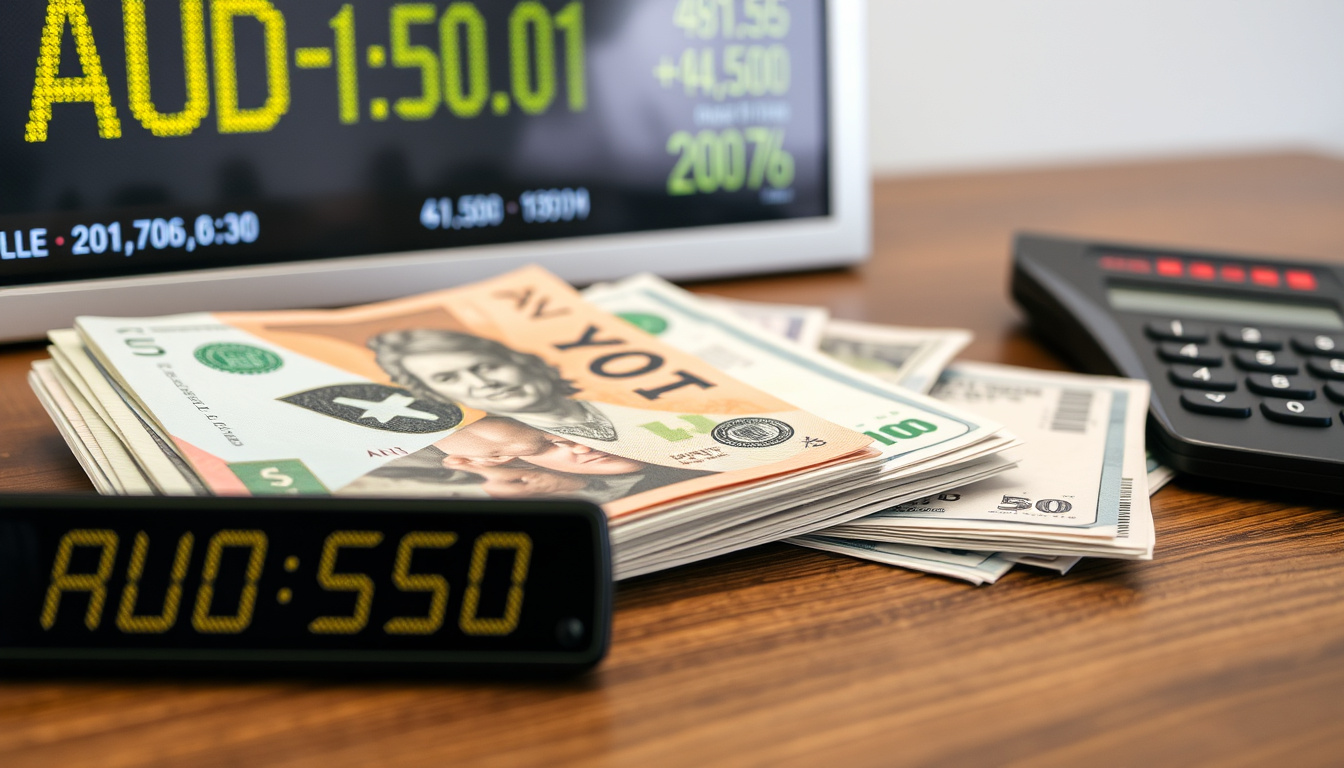

The Australian dollar has slipped nearly half a percent against the US dollar in the past 24 hours, trading around 0.7149. For anyone converting currency—whether for travel, business, or a transfer back home—those movements can change what you actually receive.
Current AUD/USD Rate: 0.7149 ·
24-Hour Change: -0.45% ·
30-Day Average (USD/AUD): 1.3813 ·
AUD/EUR Rate (Recent): ≈0.65
Quick snapshot
- AUD/USD trades at 0.7149, down 0.45% in 24 hours (Investing.com)
- Banque Misr publishes AUD/EGP at buy 38.1577 and sell 38.4629 (Banque Misr)
- Future direction of the AUD depends on commodity prices and RBA decisions (Reserve Bank of Australia)
- Exact bank rates without checking the official source – they change frequently (Reserve Bank of Australia)
- 2024 Q1: AUD/USD traded around 0.72
- June 2024: AUD fell to 0.71 amid Fed rate hike expectations
- Watch iron ore and coal prices, plus US interest rate decisions (Reserve Bank of Australia)
- Egyptian banks update rates daily – always check the official site (Central Bank of Egypt)
Key rates at a glance.
| Pair / Rate | Value | Source |
|---|---|---|
| AUD/USD | 0.7149 | Investing.com |
| USD/AUD | 1.3980 | XE |
| AUD/EGP (Banque Misr buy) | 38.1577 EGP | Banque Misr |
| AUD/EGP (Banque Misr sell) | 38.4629 EGP | Banque Misr |
| AUD/EGP (FABMISR buy) | 38.1433 EGP | FABMISR |
| AUD/EGP (FABMISR sell) | 38.4484 EGP | FABMISR |
| AUD/EGP mid-market (Wise) | ≈31.54 EGP | Wise |
| AUD/EGP mid-market (XE) | ≈31.00 EGP | XE |
| Typical bank spread (AUD/EGP) | ~0.30 EGP | Banque Misr, FABMISR |
| AUD/EUR (recent cross) | ≈0.65 | XE |
The spread between what banks buy and sell AUD for in Egypt is a consistent 0.30 EGP – a cost that adds up on larger transfers. The mid-market rate gives a clearer picture of the underlying exchange.
What is the current Australian dollar to US dollar exchange rate?
The live rate for AUD/USD sits at 0.7149 as of this writing, according to Investing.com. That means one Australian dollar buys about 71.49 US cents. The rate flips to 1.3980 for USD/AUD – so one US dollar gets you roughly 1.40 Australian dollars, based on XE data. The formula is simple: multiply your amount in AUD by the AUD/USD rate to get USD. For example, 100 AUD × 0.7149 = 71.49 USD.
How much is 100 AUD in USD?
- Calculation: 100 AUD × 0.7149 = 71.49 USD
- At an Egyptian bank using the Banque Misr sell rate, 100 AUD would cost you 38.4629 EGP × 100 = 3,846.29 EGP – but you’d then convert that to USD at the bank’s own USD/EGP rate.
How much is 1000 AUD in USD?
- Calculation: 1000 AUD × 0.7149 = 714.90 USD
For travelers sending AUD to a US bank account, the difference between the market rate and what your Egyptian bank offers can be substantial, especially on larger sums. Always check the mid-market rate on Wise before initiating a transfer.
The implication: even a small shift in the AUD/USD rate changes the final amount you receive, so timing and rate shopping both matter.
How much is 100 US dollars in Australian dollars?
To convert USD to AUD, use the inverse of the AUD/USD rate: divide the USD amount by the AUD/USD rate. At 0.7149, 100 USD = 100 ÷ 0.7149 ≈ 139.87 AUD. Alternatively, use the USD/AUD rate of 1.3980 – multiply: 100 × 1.3980 = 139.80 AUD (small rounding difference).
How much is 1000 USD in AUD?
- Calculation: 1000 USD ÷ 0.7149 = 1,398.79 AUD
Five conversion amounts to show the pattern:
| USD Amount | AUD Equivalent (at 0.7149) |
|---|---|
| 50 USD | 69.94 AUD |
| 100 USD | 139.87 AUD |
| 500 USD | 699.35 AUD |
| 1,000 USD | 1,398.79 AUD |
| 5,000 USD | 6,993.98 AUD |
The pattern is linear: each US dollar buys roughly 1.40 Australian dollars. That means if the AUD weakens further, your USD will stretch even further in Australia.
What is the Australian dollar price at Egyptian banks?
Egyptian banks publish daily AUD/EGP rates with a buy-sell spread. Here are the latest from major banks.
| Bank | AUD Buy (EGP) | AUD Sell (EGP) | Source |
|---|---|---|---|
| Banque Misr | 38.1577 | 38.4629 | Banque Misr |
| FABMISR | 38.1433 | 38.4484 | FABMISR |
| CIB Egypt (online converter) | Check live page | CIB Egypt | |
| National Bank of Egypt (NBE) | Check live page | National Bank of Egypt | |
These rates are updated daily on each bank’s website. The Central Bank of Egypt provides the official benchmark framework that banks reference. For the most accurate rate before you exchange, always check the bank’s official page directly.
Egyptian bank rates for AUD are typically far from the mid-market rate. As of this writing, the mid-market AUD/EGP rate on Wise is about 31.54 EGP – a gap of more than 6 EGP per AUD compared to the bank sell rate. That spread is the bank’s profit margin.
What this means: on a 1,000 AUD transfer, the bank spread costs you roughly 6,000 EGP more than the mid-market rate—a significant premium for convenience.
How to convert Australian dollars to other currencies?
Online converters make it easy, but the rate you see is not always what you’ll get. Here are the steps for using reliable tools.
Convert AUD to EUR
- Go to Wise or XE and enter the amount.
- Note the mid-market rate – currently around 0.65 EUR per AUD.
- If you transfer, add any fee displayed; the final rate may differ slightly.
Convert AUD to EGP
- Use Wise or XE for the mid-market rate (~31.54 EGP per AUD).
- Then check your Egyptian bank’s sell rate – the difference is your cost.
- For larger transfers, consider using a specialist service like OFX, which shows around 36.86 EGP per AUD (OFX).
The trade-off: bank convenience vs. saving on the spread. If you can plan ahead and use an online service, you may pocket 10% more Egyptian pounds for your Australian dollars.
Why is the Australian dollar price falling?
Several factors are pushing the AUD lower against the US dollar and other currencies. The research points to three main drivers.
Why is the Australian dollar so weak?
- Commodity prices: Australia is a major exporter of iron ore and coal. Falling commodity prices reduce export revenues, putting pressure on the AUD (Reserve Bank of Australia).
- Interest rate differential: Investors expect the RBA to hold rates steady while the Federal Reserve keeps US rates higher, making USD-denominated assets more attractive (RBA Deputy Governor speech).
- China demand: China is Australia’s largest trading partner. A slowdown in China’s economy reduces demand for Australian exports, weakening the AUD (Reserve Bank of Australia).
- Risk sentiment: The AUD is often treated as a risk-sensitive currency. Global uncertainty pushes traders away from riskier assets (Reserve Bank of Australia).
For anyone converting AUD to USD or EGP, the weakness is good if you’re selling AUD – but bad if you’re buying AUD. Travelers from Egypt to Australia will find their Egyptian pounds buy fewer Australian dollars than they did a year ago.
The pattern: until commodity prices rebound or the RBA signals a tighter policy, the AUD is likely to remain under pressure.
Timeline: recent AUD movements
- 2024 Q1: AUD/USD traded around 0.72
- June 2024: Fell to 0.71 as markets priced in Fed rate hikes
- Recent (2025): The rate has continued to slide, hovering around 0.7149, reflecting ongoing pressure from the factors above.
The pattern: each leg lower has coincided with a stronger US dollar or weaker commodity prices. If those trends reverse, AUD could regain ground.
Confirmed facts vs what remains unclear
Confirmed facts
- AUD/USD rate fluctuates continuously during trading hours (Investing.com)
- Banque Misr publishes its exchange rates daily on its website (Banque Misr)
- The RBA directly ties AUD weakness to commodity prices and China demand (RBA)
What’s unclear
- Future direction of the Australian dollar – depends on commodity prices and RBA decisions (RBA)
- Exact bank rates without checking the official source – they change frequently (Banque Misr)
- Whether the AUD will strengthen or weaken in the coming months – forecasts vary (RBA)
Expert perspectives
The Australian dollar weakens when investors expect lower Australian interest rates relative to other currencies, because yield demand shifts away from AUD assets.
— RBA Deputy Governor, October 2024 speech (Reserve Bank of Australia)
AUD weakness currently stems from falling commodity prices and a widening interest rate gap with the US.
— Deakin University economics team (Deakin University)
Both sources agree on the core drivers. The implication: until commodity prices recover or the RBA signals a tighter policy, the AUD is likely to remain under pressure.
For anyone in Egypt needing to convert Australian dollars, the choice is clear: either accept the bank’s spread for convenience, or plan ahead with an online service that offers near-market rates. The difference on a 5,000 AUD transfer could be as much as 6,000 EGP – money that matters.
For a detailed look at the current market, check the live AUD to USD rate and forecast on Australian Policy.
Frequently asked questions
How often does the AUD/USD exchange rate change?
It changes constantly during trading hours, second by second, as market participants buy and sell. The rate you see on a website is a snapshot at that moment.
Can I convert Australian dollars to US dollars at any Egyptian bank?
Most major Egyptian banks offer AUD conversion, but not all branches may have AUD in stock. It’s best to call ahead or use the bank’s online currency converter to check availability.
What is the best time of day to convert AUD to USD?
Liquidity is highest during the overlap of Sydney and London trading hours (roughly 8:00 AM to 11:00 AM GMT). Spreads tend to be tighter then, meaning you get a better rate.
How does the Australian dollar compare to the Euro?
As of this writing, 1 AUD is worth about 0.65 EUR. The same factors that affect AUD/USD also influence AUD/EUR – commodity prices, interest rate differentials, and global risk appetite.
Why do Egyptian banks offer different exchange rates for the Australian dollar?
Each bank sets its own buy-sell spread based on its cost of acquiring AUD and its desired profit margin. The Central Bank of Egypt provides a benchmark, but individual banks are free to quote their own rates.
Is the Australian dollar expected to strengthen or weaken in the coming months?
Forecasts are mixed. Most analysts see the AUD remaining weak unless commodity prices rebound or the RBA raises rates. Egypt-focused factors like remittance flows also play a minor role.

Rachel Walsh leads fact-checking, source verification and corrections at Coast Brief.