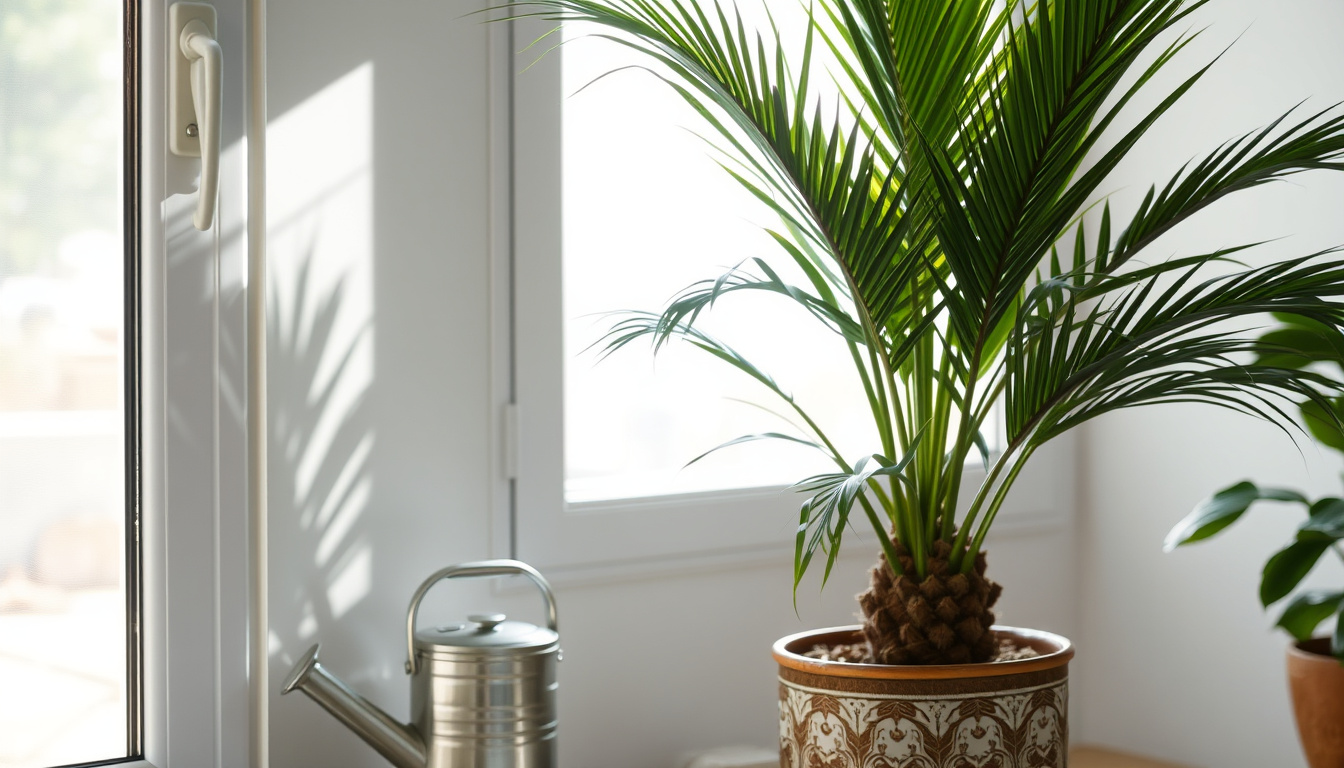

There’s a reason the Kentia palm has graced hotel lobbies and living rooms for over a century. It’s one of the few truly low-light-tolerant palms that won’t throw a fit when you forget to water it for a week. This guide walks you through the essential care routines—light, water, soil, and common pitfalls—so you can keep your Howea forsteriana looking lush without guesswork.
Scientific Name: Howea forsteriana ·
Native To: Lord Howe Island, Australia ·
Light Requirement: Low to bright indirect light ·
Mature Height Indoors: 5 to 12 feet ·
Watering Frequency: Every 1-2 weeks, let top inch dry ·
USDA Hardiness Zones: 9b-11
Quick snapshot
- Native to Lord Howe Island, Australia (New York Botanical Garden Mertz Library (botanical research library))
- Non-toxic to cats and dogs (Léon & George (indoor plant retailer))
- Slow-growing, reaching 5–12 ft indoors (Gardenia.net (plant database))
- Tolerates low light but grows slower (Joy Us Garden (indoor plant care blog))
- Exact watering frequency varies by home environment (Quirky Plants (UK plant care guide))
- Whether coffee grounds benefit palms is debated (YouTube (garden enthusiast channel))
- 1800s: Introduced to Europe as prized ornamental (Wikipedia (botanical encyclopedia))
- 19th–20th century: Victorian conservatories and hotel lobbies (Gardenia.net) (Wikipedia (botanical encyclopedia))
- Today: Widely available as indoor houseplant worldwide (Léon & George) (Wikipedia (botanical encyclopedia))
- Watch for spider mites if air is too dry (New York Botanical Garden Mertz Library)
- Consider a full-spectrum grow light for low-light corners (Joy Us Garden)
Six key specs, one takeaway: the Kentia palm is a slow, elegant survivor that demands very little—provided you respect its light and water preferences.
| Specification | Details |
|---|---|
| Scientific Name | Howea forsteriana |
| Family | Arecaceae |
| Origin | Lord Howe Island, Australia |
| Mature Height | 5–12 feet indoors |
| USDA Zone | 9b–11 |
| Toxicity | Non-toxic to cats and dogs |
Is a Kentia Palm good for indoors?
Why Kentia palms thrive in indoor conditions
- Adaptable to indoor humidity levels (New York Botanical Garden Mertz Library)
- Non-toxic to pets, safe for homes with cats and dogs (Léon & George)
- One of the few true floor plants that can handle low light without losing its shape (Joy Us Garden)
Suitability for low-light spaces
- Tolerates low light but grows slower (Joy Us Garden)
- Pale foliage and less robust leaves signal a need for more light (Joy Us Garden)
- A full-spectrum grow light can supplement when natural light is scarce (Joy Us Garden)
The pattern: the Kentia palm’s reputation as a low-light champion is well earned, but it comes with a trade-off—slower growth and less lush foliage. For office or bedroom corners that never see direct sun, this is still your best bet among large palms.
How do you care for a Kentia Palm?
Light requirements
- Bright indirect light is optimal (Gardenia.net)
- East- or west-facing windows provide ideal gentle light (Gardenia.net)
- Direct sun scorches fronds (Quirky Plants)
Watering routine
- Water when top 1–2 inches of soil feel dry (Léon & George)
- Reduce watering in winter and in low-light locations (Quirky Plants)
- Standing water causes root rot—use well-draining soil (New York Botanical Garden Mertz Library)
Humidity and temperature
- Prefers 65–85°F (18–29°C) (Léon & George)
- Average to high humidity; low humidity causes brown leaf tips (New York Botanical Garden Mertz Library)
- Use a pebble tray or humidifier to boost moisture (New York Botanical Garden Mertz Library)
Fertilizing schedule
- Use balanced liquid fertilizer monthly during spring and summer (Gardenia.net)
- Stop fertilizing in fall and winter (Léon & George)
What this means: the Kentia palm is a set-and-forget plant for most of the year—water only when the soil feels dry, keep it away from cold drafts, and feed it during the growing season. The biggest real-world mistake is overwatering.
The Kentia palm’s watering needs are forgiving, but only if you use the finger test. Office managers who water on a fixed schedule often kill palms with kindness. Check the top inch of soil—if it’s damp, wait.
Do Kentia palms like sun or shade?
Ideal light exposure for Kentia palms
- Prefers bright indirect light, similar to what they get under a forest canopy (Gardenia.net)
- East- or west-facing windows are ideal (Gardenia.net)
- Can adapt to lower light, but direct sun should be avoided (Léon & George)
Signs of too much or too little light
- Direct sun causes scorched, yellow patches on fronds (Quirky Plants)
- Too little light leads to pale, leggy growth (Joy Us Garden)
- Less robust leaves and sparse canopy indicate insufficient light (Joy Us Garden)
The trade-off: you can place a Kentia palm in a dim hallway and it will survive, but it will grow so slowly that you might mistake it for a decoration. If you want active growth, give it indirect light and rotate the pot monthly for even foliage.
The most common problem with Kentia palms is not overwatering—it’s placing them in a north-facing room far from any window. After three months, the palm will still be alive, but the leaves will be pale and thin. That’s the plant asking for a brighter spot or a grow light.
What are the disadvantages of Kentia palms?
Common issues: spider mites, yellow leaves
- Susceptible to spider mites in dry air (New York Botanical Garden Mertz Library)
- Yellow leaves often indicate overwatering or poor drainage (Léon & George)
- Brown leaf tips from dry air or inconsistent watering (Quirky Plants)
Growth rate and space requirements
- Slow growth: can take years to add a few feet (Gardenia.net)
- Needs floor space—mature plants can reach 12 ft tall indoors (Léon & George)
Cost compared to other palms
- More expensive than parlor or areca palms due to slower growth (Quirky Plants)
- Often sold as a premium specimen (Joy Us Garden)
The implication: the Kentia palm is an investment in terms of both money and patience. If you need a quick green screen, an areca palm might be a better choice. But for a long-term, low-maintenance companion, the Kentia’s slow pace is a feature, not a bug.
How often should I water a Kentia palm?
Watering schedule by season
- Water every 1–2 weeks during growing season (Léon & George)
- Allow top inch of soil to dry between waterings (New York Botanical Garden Mertz Library)
- Reduce frequency in winter (Quirky Plants)
Avoiding root rot
- Use a pot with drainage holes (Léon & George)
- Never let the pot sit in standing water (New York Botanical Garden Mertz Library)
- Well-draining soil mix is essential (Quirky Plants)
The catch: the “every 1–2 weeks” rule works for a plant in moderate light, but the same palm in a low-light corner may need water only every three weeks. Always check the soil before adding water—your specific home environment is the real schedule.
Pros and Cons of the Kentia Palm
Upsides
- Thrives in low to bright indirect light
- Non-toxic to pets and humans
- Slow growth means less frequent repotting
- Air-purifying qualities confirmed by NASA Clean Air Study
- Elegant, classic appearance suits any decor
Downsides
- Slow growth can frustrate impatient owners
- Susceptible to spider mites in dry air
- More expensive than similar palms
- Needs ample floor space at maturity
- Brown tips are common and hard to reverse
The pattern: the Kentia palm is a long-term investment that rewards patience with elegant growth.
How to grow and care for a Kentia Palm in 5 simple steps
- Choose the right spot: Place the palm near an east- or west-facing window where it gets bright, indirect light. Avoid direct sun and cold drafts. (Gardenia.net)
- Water correctly: Insert a finger into the top inch of soil. If it feels dry, water thoroughly until it drains from the bottom. Never let the pot sit in water. (Léon & George)
- Maintain humidity: Mist the fronds every few days or set the pot on a pebble tray filled with water. Brown tips are a sign the air is too dry. (New York Botanical Garden Mertz Library)
- Fertilize seasonally: Apply a balanced liquid houseplant fertilizer (20-20-20) once a month from April through August. Skip feeding in winter. (Gardenia.net)
- Prune sparingly: Remove only completely brown or dead fronds at the base. Do not cut green leaves—the palm needs them to photosynthesize. (Quirky Plants)
Why this works: each step is based on the Kentia palm’s natural behavior as an understory plant from Lord Howe Island. Replicate those conditions—filtered light, consistent moisture, humid air—and your palm will reward you with years of graceful growth.
“Kentia palms make good houseplants if given good soil, plenty of water, and at least dappled sunlight.”
— New York Botanical Garden Mertz Library (plant care FAQ)
“Indoor palms, including Kentia palms, need bright but filtered light; too little light slows growth and direct sun can scorch delicate fronds.”
— Gardenia.net (Complete Guide to Growing Palms Indoors)
For office managers looking for a low-maintenance green statement, the choice is clear: position the palm near an east-facing window and water only when the top inch is dry, or watch it slowly decline in a dark corner. The Kentia isn’t a showcase plant—it’s a reliable, forgiving companion that asks for very little and gives back a slice of tropical calm.
Frequently asked questions
Can Kentia palm be placed in a bedroom?
Yes. Kentia palms are non-toxic and tolerant of low to moderate light, making them suitable for bedrooms. Keep it near a window for best results. (NYBG Mertz Library)
Why are the tips of my Kentia palm leaves turning brown?
Most often caused by dry air, inconsistent watering, or a buildup of salts from tap water. Increase humidity and water with filtered water. (NYBG Mertz Library)
How fast does a Kentia palm grow?
Slow. Indoors it adds only a few inches per year. Full height of 5–12 feet takes many years. (Gardenia.net)
Should I mist my Kentia palm?
Misting helps increase humidity and can prevent spider mites. Mist the fronds a few times per week, especially in dry winter air. (Quirky Plants)
Does Kentia palm purify air?
Yes, it is listed in the NASA Clean Air Study as effective at removing formaldehyde and other indoor pollutants. However, you would need many plants for significant impact. (Wikipedia)
How to propagate a Kentia palm?
Propagation is difficult for home growers. Kentia palms are typically grown from seed in commercial nurseries and take months to germinate. (Léon & George)
Is Kentia palm safe for cats and dogs?
Yes, the Kentia palm is non-toxic to both cats and dogs, as confirmed by the ASPCA. It is a pet-safe houseplant. (Léon & George)
These frequently asked questions cover the most common concerns for Kentia palm owners.

Ryan Singh is Senior Reporter at Coast Brief, covering breaking stories and explainers.